1 Software verification is an ongoing activity. For any complex simulation software,
verification is an ongoing activity and is an integral part of its life cycle. There are
at least four forms of verification that evacuation models should undergo. These
are
footnote
- .1 component testing;
- .2 functional verification;
- .3 qualitative verification; and
- .4 quantitative verification.
Component testing
2 Component testing involves checking that the various components of the software
perform as intended. This involves running the software through a battery of
elementary test scenarios to ensure that the major sub-components of the model are
functioning as intended. The following is a non-exhaustive list of suggested
component tests that should be included in the verification process.
Test 1: Maintaining set walking speed in corridor
3 One person in a corridor 2 m wide and 40 m long with a walking speed of 1 m/s
should be demonstrated to cover this distance in 40 s.
Test 2: Maintaining set walking speed up staircase
4 One person on a stair 2 m wide and a length of 10 m measured along the incline with
a walking speed of 1 m/s should be demonstrated to cover this distance in 10 s.
Test 3: Maintaining set walking speed down staircase
5 One person on a stair 2 m wide and a length of 10 m measured along the incline with
a walking speed of 1 m/s should be demonstrated to cover this distance in 10 s.
Test 4: Exit flow rate
6 100 persons (p) in a room of size 8 m by 5 m with a 1 m exit located centrally on
the 5 m wall. The flow rate over the entire period should not exceed 1.33 p/s.
Test 5: Response duration
7 Ten persons in a room of size 8 m by 5 m with a 1 m exit located centrally on the 5
m wall. Impose response durations as follows uniformly distributed in the range
between 10 s and 100 s. Verify that each occupant starts moving at the appropriate
time.
Test 6: Rounding corners
8 Twenty persons approaching a left-hand corner (see figure 1) will successfully
navigate around the corner without penetrating the boundaries.
Test 7: Assignment of population demographics parameters
9 Choose a panel consisting of males 30-50 years old from table 3.4 in the appendix
to the Guidelines for the advanced evacuation analysis of new and existing
ships and distribute the walking speeds over a population of 50 people. Show
that the distributed walking speeds are consistent with the distribution specified
in the table.
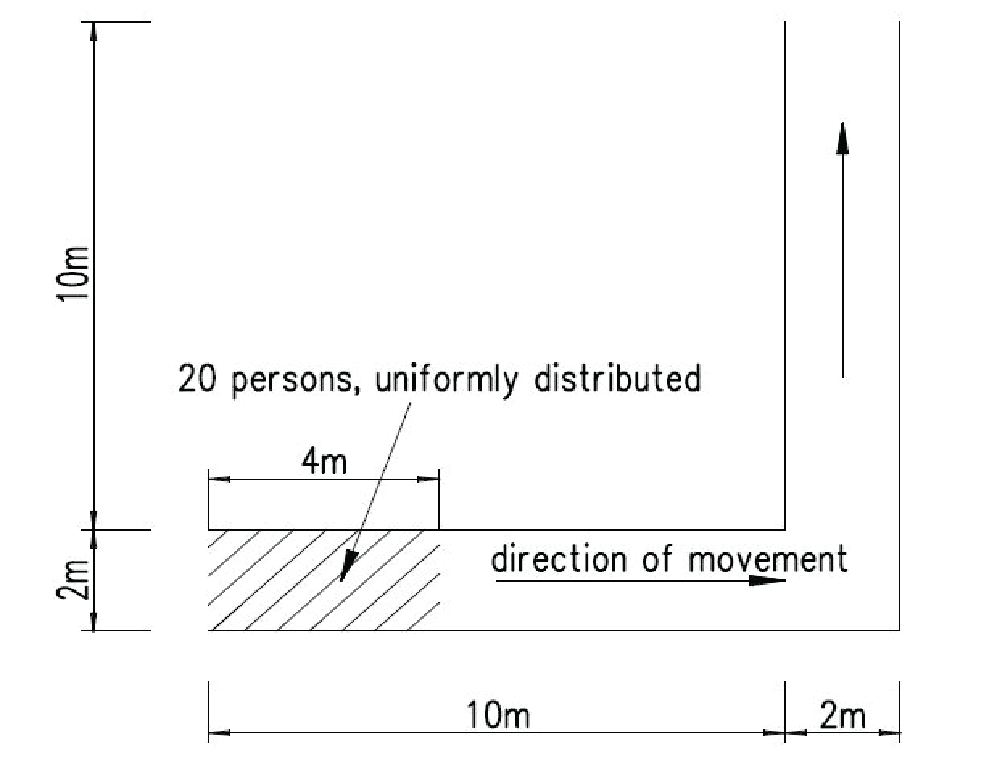
Figure 1: Transverse
corridor
Functional verification
10 Functional verification involves checking that the model possesses the ability to
exhibit the range of capabilities required to perform the intended simulations. This
requirement is task specific. To satisfy functional verification the model
developers must set out in a comprehensible manner the complete range of model
capabilities and inherent assumptions and give a guide to the correct use of these
capabilities. This information should be readily available in technical
documentation that accompanies the software.
Qualitative verification
11 The third form of model validation concerns the nature of predicted human
behaviour with informed expectations. While this is only a qualitative form of
verification, it is nevertheless important, as it demonstrates that the behavioural
capabilities built into the model are able to produce realistic behaviours.
Test 8: Counterflow – two rooms connected via a corridor
12 Two rooms 10 m wide and long connected via a corridor 10 m long and 2 m wide
starting and ending at the centre of one side of each room. Choose a panel
consisting of males 30-50 years old from table 3.4 in the appendix to the
Guidelines for the advanced evacuation analysis of new and existing ships
with instant response time and distribute the walking speeds over a population of
100 persons.
13 Step 1: One hundred persons move from room 1 to room 2, where the initial
distribution is such that the space of room 1 is filled from the left with maximum
possible density (see figure 2). The time the last person enters room 2 is recorded.
14 Step 2: Step one is repeated with an additional ten, fifty, and one hundred
persons in room 2. These persons should have identical characteristics to those in
room 1. Both rooms move off simultaneously and the duration for the last persons in
room 1 to enter room 2 is recorded. The expected result is that the recorded
duration increases with the number of persons in counterflow increases.
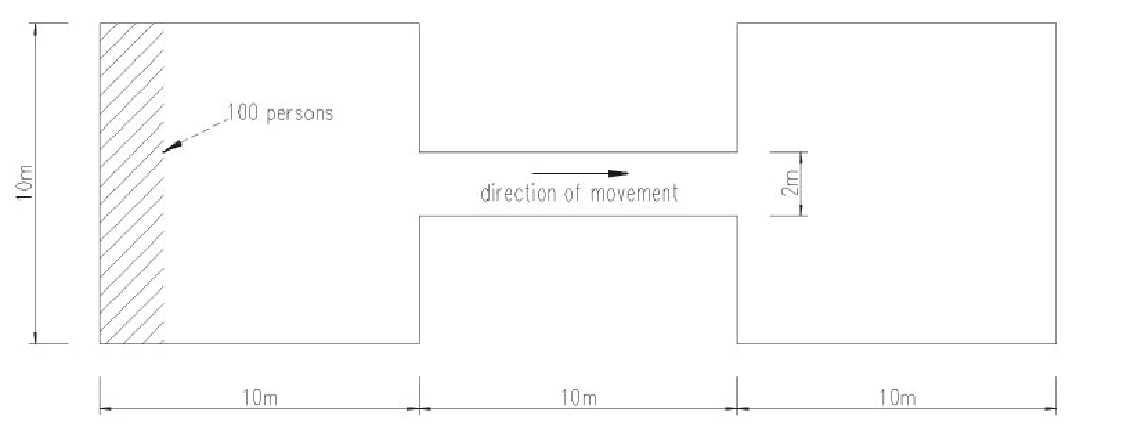
Figure 2: Two rooms connected
via a corridor
Test 9: Exit flow: crowd dissipation from a large public room
15 Public room with four exits and 1,000 persons (see figure 3) uniformly distributed
in the room. Persons leave via the nearest exits. Choose a panel consisting of males
30-50 years old from table 3.4 in the appendix to the Guidelines for the advanced
evacuation analysis of new and existing ships with instant response time and
distribute the walking speeds over a population of 1,000 persons.
Step 1: Record the amount of time the last person needs to leave the room.
Step 2: Close doors 1 and 2 and repeat step 1.
The expected result is an approximate doubling of the duration to empty the room.
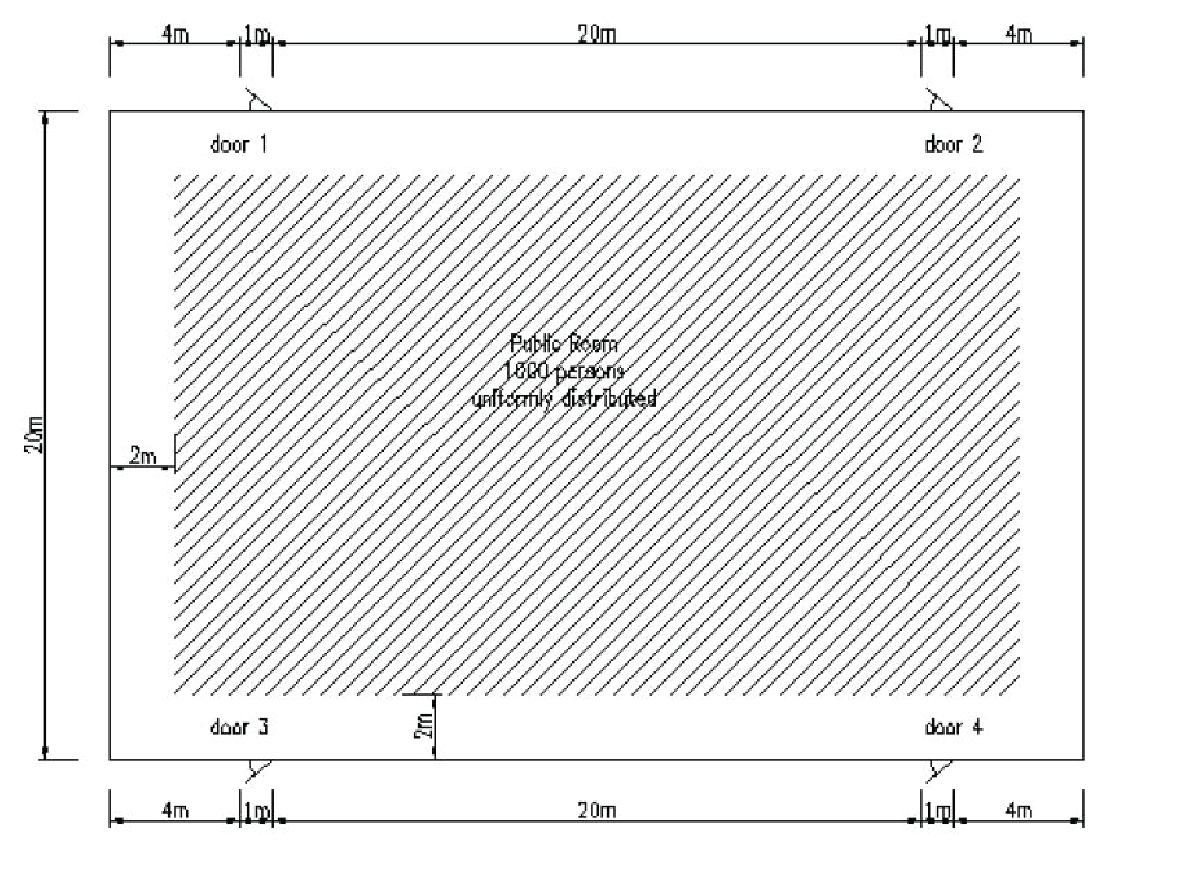
Figure 3: Exit flow from a
large public room
Test 10: Exit route allocation
16 Construct a cabin corridor section as shown in figure 4 populated as indicated
with a panel consisting of males 30-50 years old from table 3.4 in the appendix to
the Guidelines for the advanced evacuation analysis of new and existing ships
with instant response time and distribute the walking speeds over a population of 23
persons. The people in cabins 1, 2, 3, 4, 7, 8, 9, and 10 are allocated the main
exit. All the remaining passengers are allocated the secondary exit. The expected
result is that the allocated passengers move to the appropriate exits.
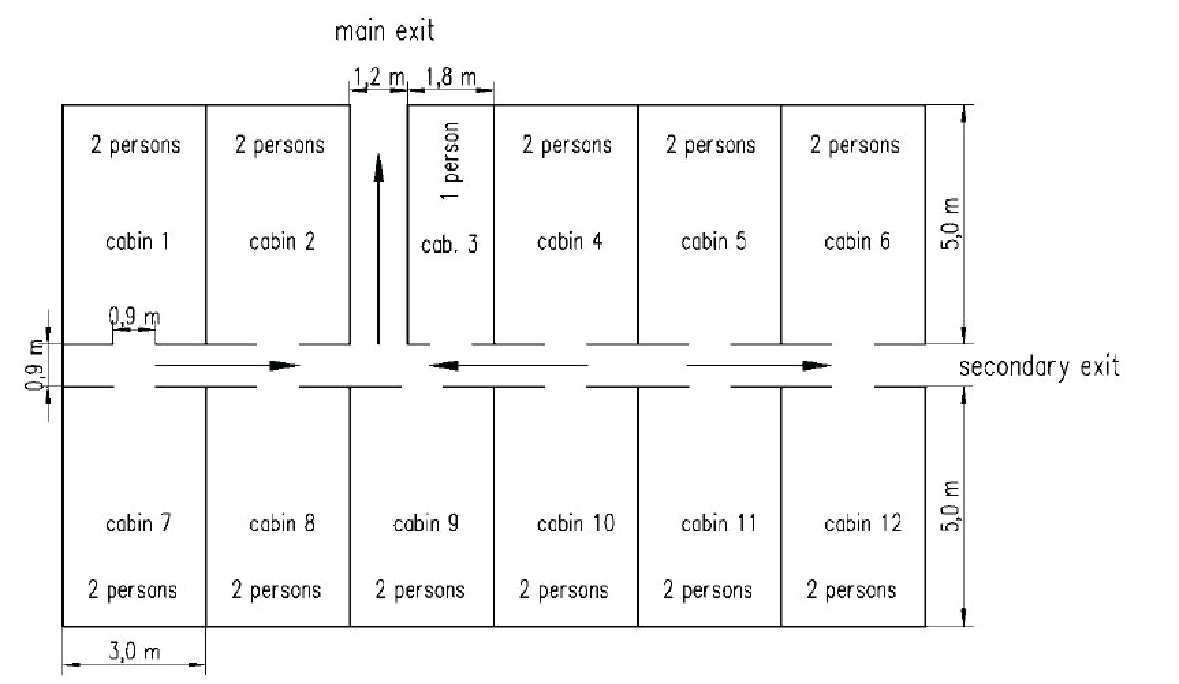
Figure 4: Cabin area
Test 11: Staircase
17 Construct a room connected to a stair via a corridor as shown in figure 5
populated as indicated with a panel consisting of males 30-50 years old from table
3.4 in the appendix to the Guidelines for the advanced evacuation analysis of new
and existing ships with instant response time and distribute the walking
speeds over a population of 150 persons. The expected result is that congestion
appears at the exit from the room, which produces a steady flow in the corridor with
the formation of congestion at the base of the stairs.
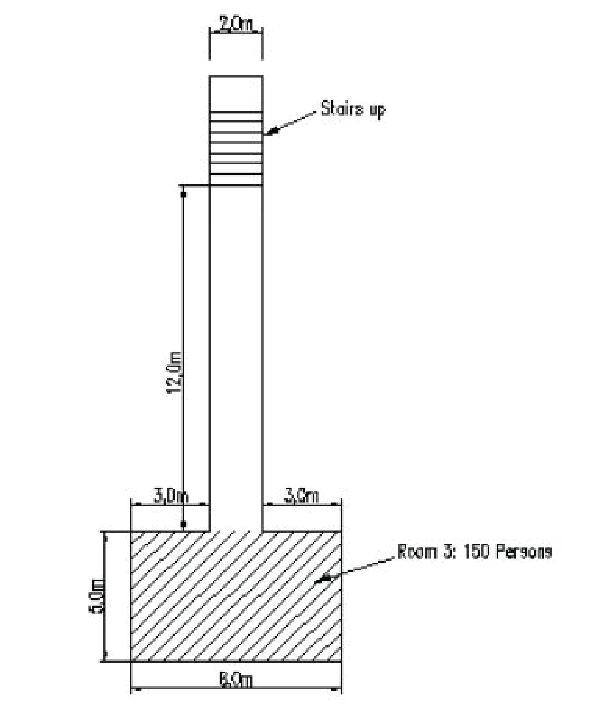
Figure 5: Escape route via
stairs
Test 12: Flow density relation
18 The software should be tested for a corridor without any obstructions. It should
be demonstrated that the flow of persons in the corridor is generally smaller at
very high population densities compared with that at moderate densities.
Quantitative verification
19 Quantitative verification involves comparing model predictions with reliable data
generated from evacuation demonstrations. At this stage of development there is
insufficient reliable experimental data to allow a thorough quantitative
verification of egress models. Until such data becomes available the first three
components of the verification process are considered sufficient.